AI & Business
Your Next Customer is an AI Agent
How AI recommendations are changing which brands consumers discover—and how businesses are adapting.
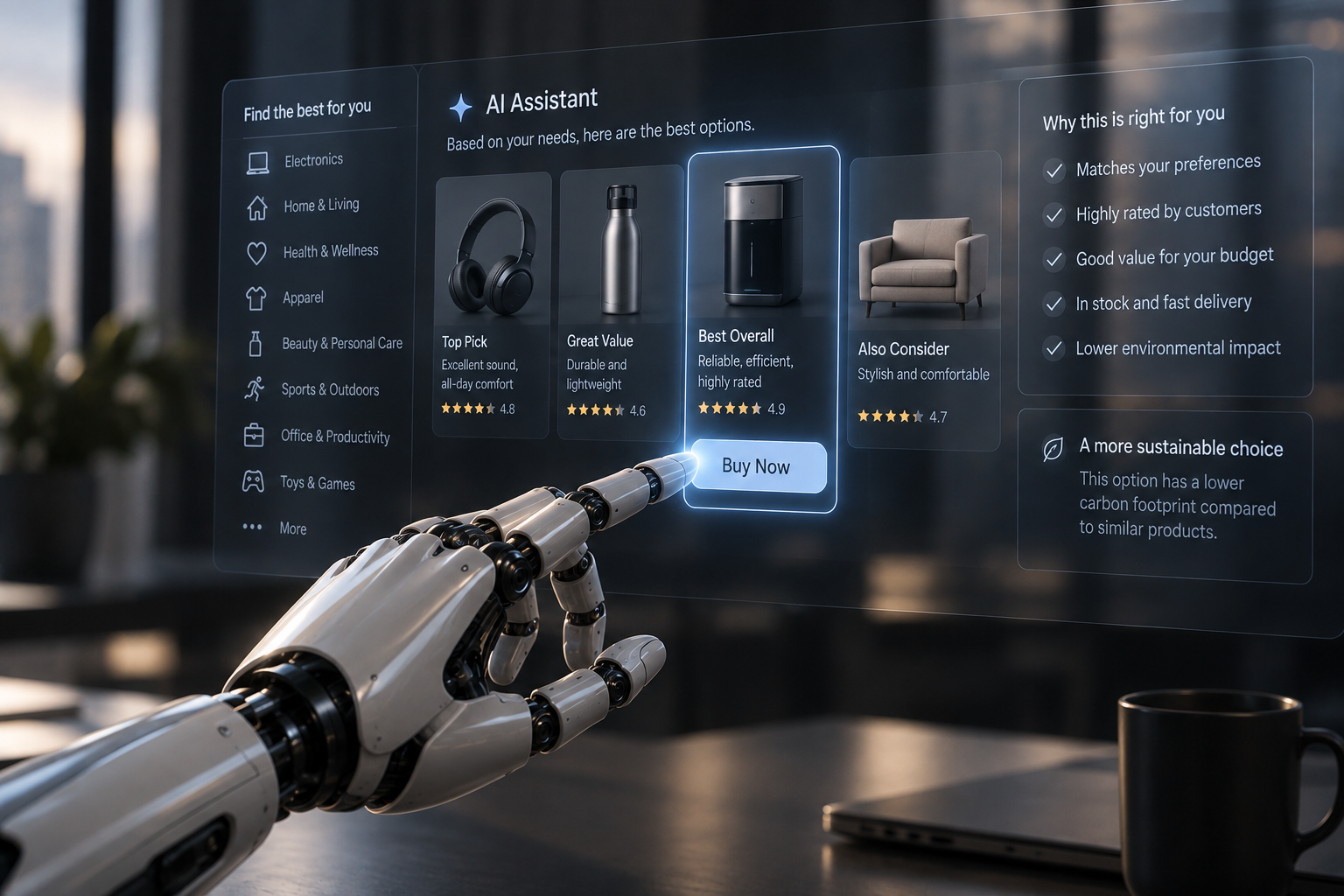
Your next customer may never visit your website, see your ad, or even know your product name. As AI agents become part of everyday life, consumers are starting to delegate more purchasing decisions to them. These agents can use information about their users' needs, preferences, and budgets to evaluate products in ways that may be very different from how people choose for themselves. The shift is already visible in commerce: Shopify reported nearly thirteenfold year-over-year growth in AI-referred orders across its merchants in the first quarter of 2026.
At a glance
The argument
AI agents are becoming an important influence on which products consumers discover, compare, and purchase.
Why it matters
Businesses can lose potential customers before their brands ever enter the consumer's consideration set.
Why now
AI-referred sales are growing, companies are adapting their marketing strategies, and Meta's October 12 launch of Muse Wonder signals further investment in AI agents capable of handling complex, multistep tasks.
What to do next
Measure AI-referred sales and recommendation visibility, then examine how AI systems find and evaluate the company's products.
What If the Agent Has Its Own Preferences?
AI agents can use information about consumers' budgets, preferences, and purchasing histories to recommend suitable products. But their own evaluation methods also influence the outcome. Different models can recommend different brands for identical customer needs, depending on the information they retrieve, the sources they trust, and how they evaluate competing claims.
In August 2026, researchers at the University of Pennsylvania's Wharton School examined approximately 26,000 AI shopping-agent tests. They found that recommendations changed significantly depending on reviews, information sources, their ordering, and the context provided to agents.
A brand that ranks highly with one assistant may never appear in another's recommendations. Understanding how these systems evaluate products is becoming an important part of customer acquisition, particularly as consumers begin relying on AI to narrow their choices before visiting a merchant's website.
Brands Are Already Seeing Results
AI-driven product discovery is already generating sales. Shopify reported that AI-referred orders across its merchants grew nearly thirteenfold year over year in the first quarter of 2026. AI-referred visitors landing on product pages converted at nearly 50% higher rates than visitors from organic search.
Cottonique, a clothing brand specializing in products for sensitive skin, reported a 276% increase in AI-referred sales, compared with 52% growth in total sales. Consumers searching for clothing suitable for skin irritation can discover Cottonique through AI recommendations without previously knowing the brand.
Other merchants have reported similar growth. ILIA Beauty said its AI-referred sales nearly tripled, while Stanley 1913 reported five times as many AI-referred orders in the United States.
“Unlike traditional SEO where the work is entirely focused on what we can do directly on our site, we are seeing that agentic optimization requires us to take a broader view and look for ways to position our brand and product story in other authoritative sources,” says Noah Gedrich, Senior Director of Commerce Technology at Stanley 1913.
Some businesses are already changing their marketing operations to improve these results. Private Label MFG, an automotive-parts retailer, worked with an optimization agency to improve its visibility in AI shopping recommendations. The company revised product descriptions to emphasize specifications and use cases, developed comparison content, strengthened its presence in external sources, and began tracking recommendations across a defined set of prompts.
Over six months, the agency reported that the company's visibility in tracked AI recommendations increased from less than 1% to more than 20%, alongside a 344% increase in AI-referral revenue.
These are agency-reported results and do not establish which individual changes produced the improvement. They do show how businesses are beginning to treat AI recommendation visibility as a measurable marketing channel.
More Capable Agents Are Entering the Market
On October 12, 2026, Meta introduced Muse Wonder and Muse Wonder Full, a new family of AI models for personal and professional agent tasks. Muse is Meta's personal AI agent, launched on September 8 and powered at launch by Muse Spark. Muse Wonder is a new AI model that Meta plans to use to power more of the existing agent's capabilities, starting with subscribers. The existing agent can navigate websites, fill out forms, negotiate on behalf of users, and complete supported purchases with their approval. According to Sensor Tower data reported by The Wall Street Journal, the Muse app has accumulated nearly 9 million downloads worldwide since its launch, although user retention has lagged ChatGPT's. Those figures describe the existing agent, not the new models.

The models extend Meta's work on agents for software development, finance, law, and other professional tasks. Meta highlights two capabilities: Active Memory, which helps the models retain and retrieve relevant information across conversations, and Active Focus, which helps them work through difficult tasks and recover from errors. Muse Wonder is available through Meta's model API and Muse Code; Muse Wonder Full is available to Muse Code subscribers.
For businesses, the significance lies in the combination of improving agent capabilities and consumer distribution. An assistant that remembers preferences, researches alternatives, navigates merchant websites, and prepares transactions could influence purchasing decisions well before a consumer visits a retailer. Meta's launch does not establish that autonomous shopping will become the dominant purchasing model, but it adds momentum to a market in which AI systems are increasingly positioned between consumers and the businesses competing for their attention.
The Customer Still Wants Control
Consumers remain reluctant to let AI spend their money. Gartner's May 2026 research found that only 11% of surveyed US consumers were willing to delegate purchasing decisions to AI, even in relatively low-stakes categories. However, 31% were willing to let AI narrow household-product choices, and 28% would do so for personal electronics.
This distinction matters. An agent can compare dozens of products and recommend three while leaving the final decision to the consumer. The brands excluded from those recommendations may never receive serious consideration, even when the consumer remains responsible for approving the purchase.
Brand awareness will continue to influence consumer preferences, and agents may consider reputation when evaluating products. But unfamiliar suppliers may also gain visibility when their offerings closely match a customer's specific requirements. For businesses, the challenge is therefore not limited to enabling autonomous transactions. It also involves understanding how AI systems determine which products deserve to be considered in the first place.
How to Market to Agents
A new marketing practice is emerging around this change. Generative Engine Optimization (GEO), also known as Answer Engine Optimization (AEO), focuses on improving how brands appear in AI-generated answers and product recommendations. Businesses are examining the information AI systems use to evaluate their products, including specifications, pricing, availability, comparisons, reviews, and independent sources.
Private Label MFG's approach illustrates the process: improve the information available about products, strengthen external visibility, and measure whether the changes affect AI recommendations and referred sales.
This also introduces a new dimension to consumer research. Companies are already using synthetic agents to simulate customer behavior and test purchasing decisions. As consumers increasingly rely on AI recommendations, marketers will also need to understand how different agents interpret customer needs and evaluate competing products.
Paid advertising is entering AI environments as well. ChatGPT now supports sponsored placements in certain experiences, allowing businesses to reach consumers researching products through AI. These advertisements are separate from organic assistant recommendations.
The influence of commercial incentives on AI recommendations is also attracting research attention. A September 2026 study, Whom Do AI Agents Work For?, found that shopping agents' treatment of sponsored listings could change depending on whether they were instructed to represent consumers or commercial platforms. These findings came from controlled experiments and do not establish misconduct by commercial AI providers.
Marketing will continue to build consumer trust, recognition, and loyalty. But brands are also beginning to compete for visibility in AI-generated recommendations, creating another audience for their marketing efforts.
Beyond Marketing
The impact extends across the customer relationship. AI Experience (AIX) is already being discussed as an approach to making products and processes accessible to agents.
AI agents can assist consumers with customer support, reservations, refunds, account management, and subscriptions. They can help review recurring charges, compare alternatives, request changes, and navigate cancellations. As these activities become easier, businesses may face customers who reassess the value of their services more frequently.
For marketing, the immediate challenge begins with product discovery. Companies are already measuring their visibility in AI recommendations and adapting how they present their offerings. The emergence of more capable agents, including those powered by models such as Muse Wonder, could extend that competition into other parts of the customer relationship, from service interactions to transaction management.
If an AI agent were choosing the best products in a company's category, would its brand make the shortlist? And if it didn't, would the company even know?
Your next customer may never know you existed—until after their agent purchased your product.